Tuesday, March 1, 2011

February 27 - Heading Home

Class 40 was up early and on the bus heading to the Istanbul airport on our final day of the leadership journey.  The majority were destined for home, one was off to Amsterdam, another to Morocco and six to Spain.  In Spain the Delegation will have several meetings following the theme of our International Seminar.  Posts to this blog will occur as appropriate between now and March 5.

As we said our goodbyes, there was a bitter sweet feeling among us.  We were excited to return to California to our loved ones and share our experiences; however we wished the seminar would not end as there is more to learn from this part of the world.

We are all thankful for the opportunity and will forever be appreciative to the California Agricultural Leadership Foundation and Alumni for this seminar. The cultural, political and historical leadership experiences will impact us in our personal and professional life.


 - Karm Bains, Dan Sutton, David Warter

Monday, February 28, 2011

February 26 - Jordan River, Nazareth

Our journey today started with a 2 hour bus ride to the Jordan River.  Along the way, we saw agricultural fields producing a variety of crops, including oranges, avocados, tomatoes, grapes, wheat, zucchini/squash, dates, and bananas.


Our first stop was Yardenit at the Jordan River, the site where Jesus was baptized by John.  At the entrance of the site, we saw ancient water pipes made of volcanic basalt stone that were part of the Barenki Aqueduct that passed by here.  The aqueduct was built in the Byzantine time at the 4th century and was the water carrier from the source of Yavniel to Bet-Yerach and Tiberias.


We loaded the bus and headed out for our next location, Nazereth.  Before we arrived in Nazareth we stopped by Canaan and had lunch.  We enjoyed a local favorite; Shawarma and Falafel. When we arrived in Nazereth it was raining, we walked throughout the bazaar and collected a few last minute momentos.  We were then able to receive a very special private tour of the caves of Nazereth. These caves were the homes of the small community where Jesus was raised. The impact of this place silenced the class.  We walked into the Basilica of Annunciation, which is located near the caves.  It was here that the angel Gabriel appeared before Mary, saying: "Behold, thou shalt conceive in thy womb, and bring forth a son, and shall call his name Jesus."  We also received a private tour of the Museum of the Basilica.  The museum contained ancient artifacts found in the caves, along with ancient stones depicting pictures of crosses and a man with a bible.


 The last phase of our day was a two hour bus ride to the airport where we left behind Tel Aviv, Israel and landed in Istanbul, Turkey.  It was a late evening flight and we were all ready for bed when we arrived.

 - Yissel Barajas, Jeff Boldt, Mike Richardson

Saturday, February 26, 2011

February 25 - Jericho, Dead Sea, West Bank

We left the hotel bright and early to get a jump on the day.  We headed off to Jericho.  We left our guide, Shimon, at the West Bank border.  As part of our journey through Israel, we have learned that while Israel is one state, very few of its residents can pass throughout it.  In fact, our bus driver grew up in a corner of Jerusalem where he has the rites of passage as an Israeli as well as a Palestinian.  For the rest of the Israelis, the Israeli government has told them not to go into Palestinian Authority (PA) territory, which includes two of our stops today, Jericho and Bethlehem.  Palestinians have to have special papers to pass into Israel.  When we returned from the Bethlehem, we had two soldiers with semi-automatic weapons board our bus to do a passport check.  Once again, we saw the multiple layers of issues between the Palestinians and Israelis.


Jericho is an oasis in the desert 500 feet below sea level.  Jericho is known for four significant stories in the Bible.  We started our quick stay in Jericho with a cable car ride up a steep mountain and arrived at Temptation Church.  This is the point in the New Testament where Jesus was tempted by the Devil.  On the spot of the temptation, a beautiful Greek Orthodox Church has been built.  After the church, we went to the ruins of Jericho, which included the old wall from the Old Testament story of Joshua, and the Battle of Jericho.  We crossed the street from the ruins and saw the spring that Elisha had purified.  On the way out of town, we saw a Sycamore tree depicting the tree from which Zacchaeus talked to Jesus.  In the town, we had a Palestinian tour guide.  He talked about how Christians and Arabs coexist well in Jericho.  He left us with the insight on all of Israel, “Remember our battles are between the governments and not between the people.”


After 13 days of intense learning and travel, Class 40 enjoyed a needed recreational swim in the Dead Sea.  The Dead Sea is the lowest point on earth at ~1200 feet below sea level.  The Dead Sea is ten times saltier than the ocean.  The Jordan River, the primary source of water for the Dead Sea has been diverted for agriculture throughout Syria, Jordan and Israel.  As a result the Dead Sea is dropping at a rate of three feet per year; this beautiful resource is shrinking.  Even in our recreational stop, we were left to ask, “How should one prioritize the water rights on the Jordan River?”  The mud at the bottom of the Dead Sea is loaded with minerals and is renown for therapeutic qualities.  Also the concentration of salt makes it very easy to float.  Much of our class covered themselves in mud and floated for thirty minutes before we headed off for more learning.


Our next stop was Bethlehem.  After visiting many important religious sites, many in our class were excited to see the birthplace of Jesus.  As mentioned above, we once again had to change tour guides.  Salwa, our Palestinian Christian, toured us through Bethlehem and shared the perspective of being a Christian in a Palestinian controlled part of a Jewish state.  We also learned about how multiple different sects of the Christian church have had possession of the church of the Jesus’s birthplace.  Interestingly, the Ottoman Empire in the mid 19th century decreed a plan on how the different sects share the birthplace of Jesus on December 24th.  This decree is still used today to determine how to share this historic site on that significant day.  In the picture, the star indicates the spot of Jesus’s birth.  In a very tightly packed three hours, we experienced Bethlehem.  Many of us want to return one day to the town and to the cave (manger) where a baby was born.


After everyone successfully passed through the border crossing, we visited the LDS Jerusalem Center for Near Eastern Studies.  Here we learned about an effort by the Mormon Church to help educate the world on Israeli and Palestinian relations.  We learned about their efforts to help reach out and build bridges throughout the country.  It was a nice scene to be able to see people trying to help the locals in “Finding Common Ground.”  

At the end of the night, we had a synthesis and our finale dinner.  In our synthesis, we grappled with our reactions to the current state of Israel and what we planned to follow closely in the news when we returned.  We had the dinner at the YMCA of Jerusalem.  It was a beautiful site.  Our class took the opportunity to reflect on what we learned on the trip and how we will behave differently when we return home as a result of this broadening experience.  For our loved ones who are reading this, we are looking forward to coming home and returning to see you.  Hopefully some of what we discussed will be obvious to you in the next few weeks and months.

 - Scott Beylik, Erik Jertberg, David Warter

Thursday, February 24, 2011

February 24, 2011 - Consulate Visit and Sites of Jerusalem

This morning we traveled to the US Consulate office of Jerusalem, located in an active monastery where three monks still reside. The Deputy Political Chief Dr. Amanda Pilz, Economic Officer Sarah Beran and Senior Commercial Specialist Assad Barsoum briefed us.  Here we discussed political issues between Israelis and Palestinians.  We discussed slow economic development progress in the West Bank as well as the timeframe for Palestinian statehood, which has had a target date of September 2011.  There is much anticipation about what will happen this fall and what implications it may have on the region.

Next, we began a tour of the old city of Jerusalem at the Mount of Olives, which offered a panoramic view of the city and Jewish tombs.  We entered the city gates walking upon a road paved in large stone blocks worn by centuries of footstep including those of Jesus.  Our tour guide, Simone, walked us through the succession of temple construction and demolition that has occurred in this holy city for millennia.  We got to visit the Jerusalem Archeological Park, which reveals some of the most amazing discoveries from the second temple period at the foot of the southern temple wall.  Finally, we approached the Western Wall, which is the only structure remaining from the original temple.  Here the class was segregated in to men and women who joined others who were there to pray.

 
Next, we followed the Via Dolorosa, which contains several Stations of the Cross that mark points along Jesus’ path to crucifixion.  The incredibly rich history and religious significance of the city was awe-inspiring and you could not help but imagine the prophets and pilgrims from thousands of years ago feeling the same.

After a quick stop along one of the streets for an authentic lunch of falafel, we took the bus to the new section of Jerusalem and toured the Israel Museum to view the Shrine of the Book.  This exhibit displays several of the Dead Sea Scrolls found in Kumran in a cave that we passed yesterday along the Dead Sea.  These scrolls represent the oldest known copy of the Old Testament.  Outside of the museum we also viewed the model of the Second Temple.  It is an impressive 1:50 scale model of Jerusalem in AD 66.


Lastly, we packed in a two-hour tour of the Yad Vashen Holocaust History Museum.  Having recently toured the Museum of Tolerance in Los Angeles, we were able to compare the two museums and further reflect on this shadow in our history.  The museum is a striking memorial to the 6 million Jews who were executed by the Nazis.

In summary, we had a fabulous educational day and saw many of the important sites in Jerusalem.  Our feet are tired, but we are eager for tomorrow when we venture into the West Bank.  Stayed tuned!

 - Randy Asadoor, Mica Heilmann, Kandi Manhart


February 23 - Dead Sea, Jerusalem

Our first stop was at a Moshav, a community of farmers who live together in the arid region. Yoel and Jenny Evans, who are members of the Moshav Noet Hakikal, greeted us. They are growers of, to name a few, dates, peppers, melons, and herbs (mainly sweet basil).  It was fascinating to see these farmers deal with the harsh conditions Mother Nature has provided them. They have found a way to have their plants thrive given the heat, salty ground, and saline water.  We got a glimpse inside a melon greenhouse where they are being grown up on vertical nets. This technique allowed the melons to get better color and shape while providing increased circulation. Due their improved methods, the amount of export-quality melons has gone from 50% up to 85%.

We also toured a pepper research greenhouse. Because the natural conditions are hard to replicate, the research must be done on site as opposed to off-site stations like we have in the US.  They were experimenting with hydroponics using shredded, recycled plastic bottles as a growing medium.  Yoel and Jenny were very proud to show us their basil growing operation and techniques as well.  They use water to dissolve and move the salts away from the root zone of the plants. Interestingly, when it rains, it actually pushes the salts back to the roots. To counteract this effect, the plants are irrigated during rainfall.


We toured a pepper packing house where the peppers were cleaned, mechanically sized, and packaged for export.  Most of the labor on this farm comes from immigrants from Thailand or native Bedouin tribe members, earning around 20 sheckles/hour ($5.50/hour).  Along the way we also stopped at the gallery of a local artist, JoJo, who made alternative metal furniture, vases, and colorful decor (www.jojo-art.com). His art is displayed all over the world.  Lastly, we were treated to a home-cooked lunch made with fresh produce from the farm.

After lunch, we took a short bus ride to our next destination, the Masada.  The Masada is a fortress built on a desert mountain plateau that rises straight up from the Dead Sea roughly 1,350 feet on all sides.  King Herod built the Masada between 20 and 10 B.C. to provide protection against his enemies.  After his death in 4 A.D., the fortress remained unoccupied until 70 A.D., when a group of Jewish soldiers, also known as Zealots, escaped to the Masada after the Romans conquered Jerusalem. Once the Romans tracked the Zealots to the Masada, they deployed 10,000 of their best soldiers to capture the 900 Jews (300 soldiers and their family members).

The Masada fortress was built to be able to sustain life for an indefinite period.  It had a highly sophisticated water system and the Zealots were able to grow vegetables, crops, and raise sheep on the small plateau.  The Zealots were able to hold off the Romans for three years until the Romans were able to build a large ramp to finally breach the fortress wall.  Rather than become a slaves to the Romans, the Zealots selected 10 brave soldiers to kill all of the women and children and then kill the remaining 9 soldiers, leaving the last soldier to fall to his own sword.  The Romans entered the Masada the next day to find all dead but one woman and child.


After the Masada, we hopped on the bus for our drive to Jerusalem.  On the way, we made a pit stop at a tourist trap where a number of our class fellows went for a spin on a camel.  It didn’t cost any money to ride the camel, but it was $5 to get off!


It was dark when we finally arrived in Jerusalem, but our tour guide took us to a vista point on Mt. Scopus for a view looking over the city and blessed us with a traditional Jewish prayer.  The city lights were spectacular and our class is looking forward to our tour of Jerusalem.


Bill Hammond, Doug Phillips, and Chris Amble


Wednesday, February 23, 2011

February 22, 2011 - Tel Aviv, Israel

Our day began with meeting US Embassy personnel. As we have seen so far, US representatives from our Embassy are very impressive people.  We are all proud to have these people representing us.  We were fortunate to have six representatives discuss the political, economic and security issues during a time of fast paced change in the Middle East. We were graced with the Minister of Economic Affairs, General Console, Israeli attaché to the USDA, Chief of Economic Affairs, Security attaché, and the Deputy Political Counselor. The insights to not just Israel but the entire region afforded us a glimpse into a culture and country in transition.  They were also frank that the pace of the change in the region has even surprised them. The Security attaché illuminated us into the current states of Gaza, the West Bank, and the surrounding nations influences in this volatile and tumultuous area.  When he described the Gaza strip as a “maximum security prison with guards on both sides,” he painted a vivid picture of a corner of a world that we may never have the opportunity to see.  We also learned that in this area the goal of the people seems to be to manage the issues and not to solve them because many of the issues are viewed as insolvable.  The Political attaché opined about Egypt, Tunisia and how the revolts are changing these countries’ regional alliances. There is great opportunity for industry within the nation of Israel, especially in agriculture where they are currently importing seventy percent of their pistachios and great deal of their fruit from California. There is further growth potential for us to increase the market share for many of our commodities, as the Israeli citizens are willing to pay a premium for high-quality agricultural products.


We traveled to Mekorot Water Company for an afternoon presentation on water reclaim systems, desalination, rain enhancement, and other water technologies for the nation of Israel. Mekorot provides 70% of the overall water consumed in Israel. They are using a number of high-technology techniques to enhance their water quality, capture, and efficiency.  Israel, similarly to California, is experiencing a water shortage.  Most of the land is classified as a desert.  In response they have built water reclaim systems that allow for 75% of their water to be reused; they have a new goal of 90% reuse.  They have also focused on water source diversification.  While they use the water from the Sea of Galilee and groundwater in the northern regions as fresh water sources, they have built 30 desalination plants and have plans to build two more large seawater desalination plants in order to ensure that the country’s overall water balance is neutral.  This diversification has also allowed for greater security.  They are online testing all of the sources for potential contaminants and have the ability to shut down any one leg at any given time.  Overall, we learned that many of our CA municipalities have more advanced wastewater digesters than Mekorot; however, Mekorot has created a holistic water strategy plan for their nation.  By executing this plan through innovative techniques and the technologies Mekorot is securing Israel’s future in water.


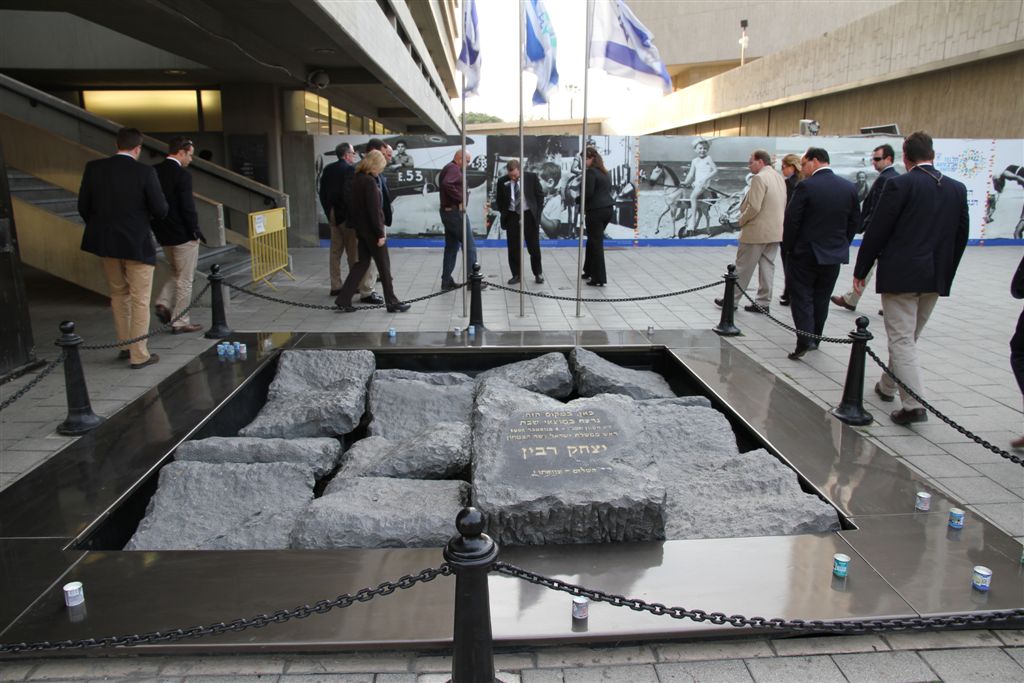
On our return trip from Mekorot, Shimon, our tour guide, showed us more of the wonderful city of Tel Aviv. On the north side of the city, near the university, we had a beautiful view of the modern city of Tel Aviv from a hilltop. As we traveled towards the hotel, we stopped and visited the memorial for Yitzhak Rabin, the Prime Minister of Israel who was assassinated in November of 1995. Yitzhak was the embodiment of the ideal Israeli male: a military man who became a politician and gave everything to the state of Israel. The people of Israel equate this tragic event to the JFK assassination, and we feel privileged to have visited the sight and hear details about this great individual.


We ended our day with a very special discussion on Israel, it’s people and politics with Aluf Benn.  Aluf is the Editor in Chief of the Haaretz newspaper and a frequent contributor to the NY Times, Washington Post, WSJ and Newsweek.  We learned from Aluf that Israelis are great at going through red tape, cutting corners, not waiting in line and just doing the job.  While this has led to them being the Start-Up Nation and resulted in numerous military successes, this has also the lack of many well run large companies.  It has also driven Israeli politics, which he described as a “loser take all” system.  As a member of the media, Aluf discussed the Israeli reaction to media stories.  He said that stories that are negative about Israeli policies frequently are viewed as not being truthful while the same reporter the next day could run a similar story on China and all would trust all his reporting.  In our question and answer session, Aluf enlightened us on how US Israeli relations and US Middle East relations have changed over the last few years based both on US policy changes as well as changes in policy by key countries such as Turkey.  He said that most countries in the region would likely take a “grocery store” stance to super powers.  There are now enough super powers that you shop around with the super powers and show you are willing to switch alliances frequently in order to arrange the best deal.  After having spent time in Turkey, we were able to synthesize his opinion into our collective views on the world.


-Kyle Goehring, Jim Peterson, and David Warter


Tuesday, February 22, 2011

February 21 - Tel Aviv

No bus accidents!

We had breakfast and took walks around the kibbutz.  Some of the class took a tour of the ball-valve plant, owned and operated by the kibbutz.  We loaded the bus and saw the Negev Desert for the first time in daylight.  On one side of the road we noticed Israeli military conducting military operations.  On the other side we saw a Bedouin community.  Their temporary dwellings used to be tents and are now metal sheds with some permanent structures.  Along the way our tour guide discussed some of the political issues with the Bedouin communities and the Israeli government. 


During our 45-minute drive to our first meeting we couldn’t but help to notice the very arid and dry conditions of the Negev desert.  We wondered how communities and people once traveled these deserts to survive and transport goods.

We arrived at our first stop of the day at Netafim where Itik Inbar greeted us.  Itik serves as the marketing arm for Netafim in their Egypt sales.  Itik outlined the history of the Hizzarim Kibbutz that eventually purchased the technology of drip irrigation.  He provided us with a presentation on the history of drip irrigation and the future potentials this technology can achieve.


The development of a drip irrigation system took almost 5 years to develop.  The biggest challenge was taking pressurized water and slowing it down to allow for a slow drip.  After the kibbutz bought the patent, they began to introduce to Israeli farmers.  Israel has a water shortage and a growing population therefore requiring water conservation. Due to the success of the drip system, 90% of Israel’s domestic consumption of vegetables is grown in the desert.  Netafim has also developed nano irrigation, subsurface drip irrigation, low-pressure systems and advanced Ag technology for greenhouses.  For the future, Netafim is developing crop management technology and precise nutrigation via state-of-the-art technology.


After leaving Netafim we were very fortunate to have coordinated an unscheduled stop with Bedouin tribe members.  On the plane ride to Tel Aviv, Dr. Thomas had struck up a conversation with Yeela Raanam.  It turned out that Yeela is an advocate for the Bedouin communities. She offered to meet with our class to discuss more in depth the political issues and struggles of the Bedouins.  Sarmon and Hussein accompanied Leeya to meet with us and to communicate the difficulties they are having with the current Israeli policies of discrimination against the Bedouin communities. 


The Israeli policies are aimed at the Bedouins integrating into their society.  However, this is a community of Arab nomads who were there before Israel was created.  Their cultural has a strong duty to extended family and community, and it is a culture that loves the earth and the open spaces.  There is also severe racism against the Bedouins. The government has tried building Bedouin communities, but these have turned into slums because almost 100% of their income is animal agriculture based, which they can not practice in an urban environment.  They also live in “Unrecognized Villages” without infrastructure, water, electricity, etc. 


Our next stop was to the Youth Village Ben-Shemen.  This youth village had 850 students and 400 are boarding students.  The emphasis of this school was agriculture.  The students of the school farmed 500 acres and each student was committed to 7.5 hours of work on the farm each week.  The three main principles of the school are 1.) Provide a quality education, 2.) Love of earth and agriculture, and 3.) Ability to live socially among diverse peers.  We had the privilege to eat lunch at the school and receive a brief presentation from Ilana Tischler.  Ilana is the director general of the school.

 
While at the school we toured the high school facilities where we had the opportunity to interact with the students.  We witnessed a small team of students that preparing to participate in a NASA competition in robotics.  What these students had already accomplished was amazing.


We then toured a small portion of the school’s farm.  We were able to see the school’s dairy, stable, and poultry operation.  It was incredible to see each of these operations being completely staffed and run by the students of the school.

 
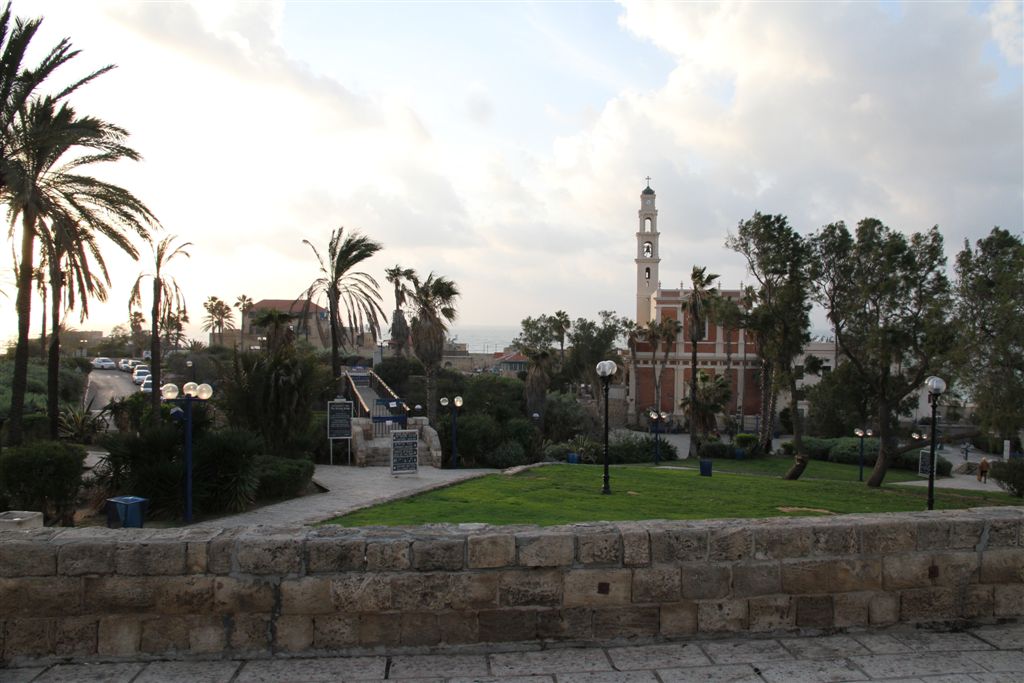
As we finished our ride to our hotel in Tel Aviv we made a quick stop at Old Yafo.  Old Yafo is best known for the Prophet Jonas.  There was an ancient wall from the time of the Greeks, as well as ancient Egyptian ruins.  We made a small hike to the top of a hill to witness a breathtaking view of the Tel Aviv coastline.  We eventually arrived to our accommodations where as a class we reflected on the impactful experiences we were exposed to today.  For the rest of the evening we ventured out into Tel Aviv for dinner and witness the local culture of this part of the Middle East.


 - Melissa Duflock, Matt Jones, Dan Sutton